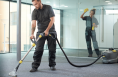
A commercial deep clean is a one-off, top-to-bottom clean that reaches the places regular cleaning does not cover week to week, and January is one of the best times to book one. Offices are often quieter, December has left its mark, and a proper clean sets the standard for the rest of the year. Here is what a deep clean involves and how to plan one without disrupting your business in Cambridge or the surrounding towns.
Why is January a good time for a deep clean?
- The Christmas mess. Parties, food in desk drawers and a busy kitchen leave fridges, microwaves and carpets needing more than a normal clean.
- Winter dirt. Wet shoes and grit from car parks get walked straight onto entrance carpets and hard floors.
- The heating is on. Dust collects on radiators, vents and high ledges and keeps going round the building.
- Quieter buildings. With people still on leave in early January, it is easier to clear rooms and work around fewer staff.
- A fresh budget. Many businesses plan maintenance at the start of the year, and a deep clean is easier to sign off now than squeezed in later.
What does a commercial deep clean cover?
Regular cleaning keeps a building tidy: bins, desks, vacuuming, kitchens and toilets. A deep clean goes after everything else. Typically that includes:
- high-level dusting of light fittings, vents, tops of cupboards and partitions
- moving furniture to clean behind and underneath
- carpet and upholstery cleaning by hot water extraction
- kitchens: inside fridges, microwaves, ovens and cupboards, and dishwasher filters
- washrooms: descaling, grout, behind toilets and around cubicle fixings
- machine scrubbing hard floors
- skirting boards, door frames, internal glass and phones and keyboards
Laboratories and specialist areas need extra care, with cleaners who understand COSHH and the site’s own rules.
How do you plan a deep clean with minimal disruption?
- Walk round first. Agree the scope room by room, including what is out of bounds, such as server rooms or secure areas.
- Pick the timing. Evenings and weekends suit most offices. Large sites can be done zone by zone.
- Tell staff. Ask everyone to clear desks and empty the fridge beforehand. Desks covered in paperwork cannot be cleaned properly, and that is the most common reason a deep clean disappoints.
- Do carpets last thing on a Friday so they are dry by Monday.
- Sort access. Keys, alarm codes, lifts and parking all need agreeing in advance.
- Check it together. A walk-round afterwards picks up anything missed while the team is still on site.
How often does a business need a deep clean?
Most offices benefit from a deep clean once or twice a year, with January and the summer holiday period being the usual choices. Busy kitchens, washrooms, schools and buildings with high footfall may need it more often. It is also worth booking one when you move into new premises or after a refit, and if your regular office cleaning is good, each deep clean should be quicker than the last.
Frequently asked questions
How long does a commercial deep clean take?
It depends on the size of the building and the scope. A small office can often be done in a day or over a weekend, while larger sites are usually done in phases. We agree a timeframe when we quote.
Do we need to close the building for a deep clean?
Usually not. Most deep cleans are done in the evenings, at weekends or zone by zone, so staff can keep working.
Should carpets be part of a deep clean?
In most offices, yes. Hot water extraction lifts the dirt that vacuuming leaves behind, and it is easiest to do when the building is quiet and carpets have time to dry.
How CamClean can help
We carry out commercial deep cleaning for offices, labs, schools and business premises across Cambridge, Cambourne, St Neots and Huntingdon. Our staff are vetted and insured, and we can work evenings and weekends. Call 01954 783308 or request a free, tailored quote.