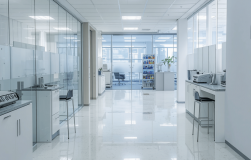
Laboratory cleaning and COSHH go hand in hand. Your cleaning contractor must assess the risks of every chemical they bring on site, follow your lab’s own controls for the hazards already there, and keep records you can show an auditor. On a science park around Cambridge, that is what stops a cleaner wiping a bench or moving a container they should never have touched.
Laboratory cleaning and COSHH: what the law requires
The Control of Substances Hazardous to Health Regulations 2002 (COSHH) apply to cleaning products just as they do to lab reagents. In practice, your contractor should have:
- A COSHH assessment for every product they use on your site.
- Safety data sheets for those products, available on site.
- The right PPE for each task, and cleaners trained to use it.
- A locked store for cleaning chemicals, away from lab areas.
COSHH works both ways. You need to tell the contractor about the hazards in the areas they clean, and they need to tell you what they are bringing in.
What should cleaners never touch in a laboratory?
This is where most problems start, so it needs to be written into the specification and covered at induction. Unless specifically agreed, cleaners should not touch:
- Anything on benches within marked work areas, including samples, glassware and labelled containers.
- The inside of fume cupboards and biosafety cabinets.
- Sample fridges, freezers and incubators.
- Instruments and equipment, even just to dust them.
- Sharps bins, chemical waste and clinical waste containers.
- Any spill they cannot identify. The rule is simple: leave it, keep people away and report it.
Restricted areas, waste and chemical compatibility
Most labs have areas with different access levels. Cleaners should know exactly which rooms they can enter, when, and whether they need an escort. A floor plan marked up by zone is far clearer than a verbal briefing.
Waste segregation needs the same clarity. Cleaners usually handle general waste and recycling, while hazardous streams stay with lab staff. Your site’s colour coding should be explained at induction, and bins should never be combined to save a trip.
Chemical compatibility is often overlooked. Bleach mixed with acidic cleaners or ammonia-based products gives off toxic gas, so a contractor’s product list should be agreed with your lab manager, not chosen by whoever restocks the cupboard. Disinfectants also need to suit your surfaces, such as epoxy resin benches and stainless steel, and no new product should be brought in without an updated assessment.
Induction and documentation for audits
When an auditor asks how cleaning is controlled, you should be able to hand over:
- Signed induction records for every cleaner on site, including cover staff.
- COSHH assessments and safety data sheets for each product used.
- The cleaning specification and completed task sign-off sheets.
- Supervisor audit records and any corrective actions.
- Training records and incident or near-miss reports.
Ask for these before the contract starts, not after the first audit.
Frequently asked questions
Do laboratory cleaners need special training?
They should be COSHH-trained and fully inducted on your site before working unsupervised. They also need to understand your access rules, waste streams and what not to touch.
Should cleaners empty laboratory waste?
Normally only general waste and recycling. Chemical, clinical and sharps waste should be handled by lab staff under your own procedures unless the contractor has been specifically trained and it is written into the specification.
Can laboratory cleaning be done out of hours?
Yes. Many labs prefer early morning, evening or weekend cleans, but out-of-hours work needs clear rules on which areas are accessible when no lab staff are present.
How CamClean can help
We provide laboratory cleaning in Cambridge for science and biotech clients, with COSHH-trained, vetted and insured staff and cleans scheduled around your working hours. We also offer commercial deep cleaning for shutdowns and refits. Call 01954 783308 or request a free, tailored quote.